

Adico has shaped Portuguese design for over a century, crafting enduring metal furniture that reflects the nation’s cultural identity and commitment to quality.
In a quiet corner of Portugal, near the coastal breeze of Estarreja, a singular narrative in metal has been unfolding for over a century. Adico is not a brand that chases trends. It doesn’t need to. Its forms, lines, and materials speak in the quiet language of permanence — of objects that belong to memory, to place, and to the shared rituals of everyday life.
To speak of Adico is to speak of presence. Of chairs that have witnessed conversations in cafés, of tables that have held the weight of both coffee cups and conversation. Founded in 1920, Adico has long held a place not only in Portuguese homes and public spaces, but in the country’s collective design identity. And yet, for all its longevity, its ethos remains grounded: to create furniture that endures — materially, culturally, and aesthetically.
The company was established by Adelino Dias Costa, a self-taught craftsman whose sensitivity to form and function helped shape one of Portugal’s earliest industrial design companies. From the beginning, Adico was concerned with utility — producing metal furniture, safes, and hospital equipment that served practical needs. But even then, there was something quietly elegant about its approach. Metal, often seen as cold or purely functional, was softened into fluid curves, balanced proportions, and timeless silhouettes.
Adico’s evolution has not been marked by radical shifts, but by a steady refinement of its founding principles. While many companies have leaned into fast cycles and shifting aesthetics, Adico has remained anchored — a brand more concerned with continuity than reinvention. This is not to say it hasn’t evolved. Recent decades have brought new designers, fresh collaborations, and an openness to dialogue with contemporary design culture. Yet every new gesture is grounded in a century-old respect for process, material, and form.
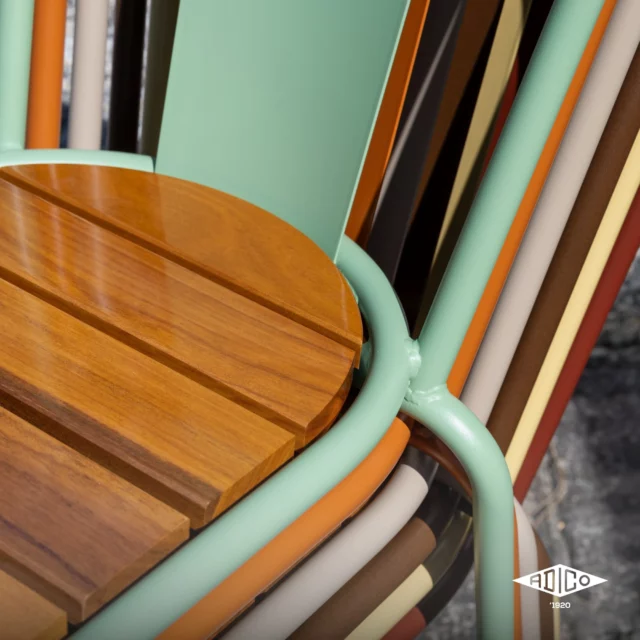
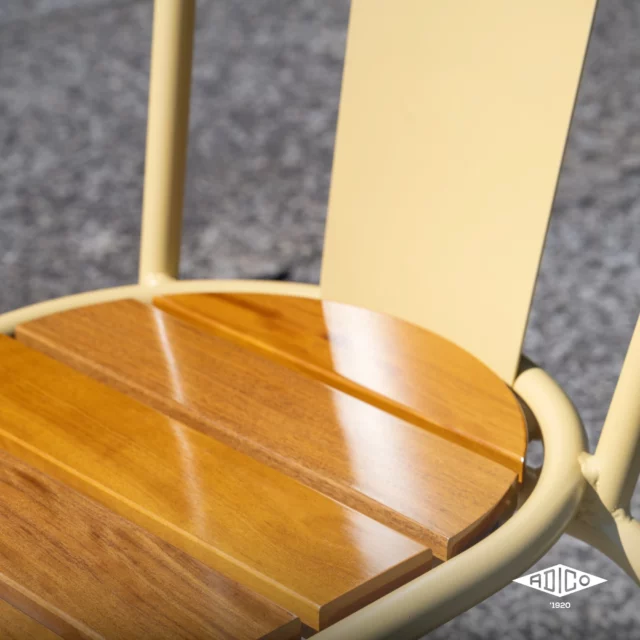

This balance between heritage and forward motion is perhaps most clearly embodied in the brand’s most iconic piece: the 5008 model, known simply as a cadeira portuguesa — the Portuguese Chair. Ubiquitous yet often unnoticed, it has become a quiet symbol of the country’s design legacy. Found in terraces, canteens, and cafés from Lisbon to Leiria, its elegant lines and tubular structure feel as natural today as they did when it first emerged in the 1930s. It doesn’t demand attention; it simply fits — into landscapes, into routines, into memory.
But Adico’s legacy is not only about a single object. Its production process continues to take place locally, preserving traditional metalworking techniques while integrating contemporary approaches to sustainability and efficiency. The brand’s recent efforts to map its presence across the globe — from Paris to Osaka — reflect a growing recognition of Portuguese design on the international stage. It is a quiet kind of globalism, rooted not in spectacle but in integrity.
To encounter an Adico piece is to encounter time — both the time embedded in the making, and the time the object asks of you. These are pieces that age with dignity. That outlive fashion. That remind us that good design is not necessarily the loudest, but often the most enduring.
As it moves into its second century, Adico continues to create with the same intentionality that has shaped its legacy. There is no need for reinvention when the foundation is this solid. Instead, there is space — to evolve slowly, to honor what endures, and to carry forward the quiet discipline of making with care.
We don’t feature Adico because it was time to choose a brand. We write about Adico because we love it — because its work has already earned a place in the cultural landscape of Portugal, and in the collective imagination of those who believe that design, at its best, is both ordinary and timeless.